Showing posts with label Celtic saint. Show all posts

Saturday, 1 September 2012

Lindisfarne Days - the Sixth Day

Patrick - dear saint of our Isle

Then God said, "Let us make man in our image, in our likeness, and let them rule over the fish of the sea and the birds of the air, over the livestock, over all the earth, and over all the creatures that move along the ground."


There's a fair amount of information on St Patrick  this site is fairly open to both legend and fact - such as it is.

Patrick's missionary work was nowhere near Lindisfarne and centuries earlier than the brothers and sisters we celebrate this week.

Which, I suppose, is the point on several levels. 


To be reminded that we are all 'dwarves standing on the shoulders of giants'. That we are all beholden in our belonging and our traditions to those who have gone before. We have all sat at the feet of someone who told us this story that we seek to be a part of. 

Also, that Lindisfarne, and anywhere else that we regard as sacred, may be places for rest and renewal, but our ministry is most often in the place where we live and the people that we meet in our ordinary but 'extraordinary' lives. 

And then, that we should be aware of this world where we live; that the missionaries carried the faith across the country; the holy road led everywhere; reached everyone. And that there are memories are left behind if we only open our eyes.


St Patrick's Well isn't my nearest sacred space but the one I would probably have never visited if I hadn't made the commitment to 'look at the ground beneath my feet'.


Part of the nature reserve - known as the 'Wirral Way' - travels through Bromborough, about five miles from my home.

Bromborough is one of the possible sites of an epic battle in 937, the Battle of Brunanburh, This is the first battle where England came together as one country, to fight the combined forces of the Norsemen and the Scots, and historians consider it the birthplace of England; this area is known as Dibbinsdale being centred around the River Dibbin. It's a mixture of meadow, riverside wetland and retains some of the ancient woodland of the 12th Century forest.


A breath of water and woodland surrounded by busy rush hour traffic; industrial units and a shopping outlet; I have driven past hundreds of times always on my way to 'somewhere else'.
This summer I turned into the sandstone lined lane; came to a halt in the tree encircled car park and took a look at the reserve map with the philosophical comment 'you are here'.

And on one of the many woodland walks there was a label and a small detour over a wooden bridge to a spot marked 'St Patrick's Well'.

St Patrick is reputed to have blessed this well, a scarce source of fresh water at the time, before his mission to Ireland in 432. Tradition or otherwise - this little corner has kept the title ever since.

Water has always been a sacred place in pagan and celtic spirituality. It would make perfect sense as the celts moved from pagan to Christian belief to have their source of water blessed by a man who embodied the strengths of the Druids and the Christian faith. You would wonder why it wasn't more famous; why, indeed, it didn't have it's own pilgrimage trail?


                                                  On seeing the sign I was a little hesitant to go further; what if it was neglected; vandalised; graffittied? What if it was a dreadful disappointment? What if it wasn't even there?

But it was; the walk lead downhill into a sandstone gorge. I found myself following a path below the surface of the modern road - beside the path the runoff from the rain mingled with the cascades of a brook that widened into small river.  An arrowed sign that seemed to lead nowhere and there it was - a small squared-off entrance with markers of ancient masonery held in the grip of the deep roots of a beech tree. The water clear and bright above the debris of nature's leavings - seed pods, twigs, leaves and crab apples.


A certain neglectful elegance; a stillness; a sense of presence that was both spiritual and remarkably mundane.

There was nowhere to sit apart from the floor and the weather wasn't kind - leaning against the rocky outcrop the sound of the traffic above faded into a quiet humm. Any sense of moving on disappeared; stillness descended.

As dogwalkers and bmx bikers passed by there was a sense of timelines crossing; boundaries being pulled down. Sixteen hundred years plus of people coming to the Well; a place of life, of faith, of hope. And here I am today seeking the same refreshment of life.

Even if Patrick hadn't been here although there was a plain-ness and a practicality that would have certainly suited his spirituality - this place, this water was valued; was important; was sacred in a discrete way; sacred enough to remain inviolate. Somewhat returned to Creation; but why not? Why not?

God in the Everyday; the Everywhere - in a walk through woodland; across tidal  sands or sitting in a ancient church. Holy men and women have come before us whether or not we know their names - we are all part of a greater realm - we just have to take the time to step out of the normal way of things now and again.

I count the four hour plus drive to Lindisfarne as well worth it even when it is just for the day; but I can't do it every day.  Perhaps this is a good reminder that before we start out on our pilgrimages of faith we should first know where it is we start from.

As Mary Oliver says:

"Instructions for living a life.

Pay attention.
Be astonished.
Tell about it." 

wordinthehand 2012


The Northumbria Community's Compline for Saturday  here

Friday, 31 August 2012

Lindisfarne Days - The Fifth Day


Boisil - Healer and Teacher

                                              Genesis 1:22
God blessed them and said, "Be fruitful and increase in number and fill the water in the seas, and let the birds increase on the earth.
Saint Boisil, Confessor, was a Northumbrian trained  at Lindisfarne Priory by Saint Aidan.  He became a monk and quickly rose to be Prior of Melrose Abbey. Bede tells us that the saint was a man of  virtues as well as an eminent scholar. 

He was widely known and sought after for his herbal remedies, and for his blessing of the healing properties of the two local springs containing iron salts. Interestingly, these wells are clearly marked on the OS maps of today - the Wellbury Well in the bank just below his chapel, and the Hare (corruption of ‘Heir’ meaning ‘Holy’)Well which lies near St Boswells Burn. 


When the young Saint Cuthbert came to Melrose Abbey rather than the more famous Lindisfarne, Boisil welcomed him at the gate and said  to the monks with whom he was standing: "Behold the servant of the Lord". The Abbot soon gave permission for Cuthbert to enter the community, and Boisil ensured that he "watched, prayed, worked and read harder than anyone else". They became great friends. Both were given to travelling amongst the villages neighbouring Melrose and preaching to the local people.

In AD 659,  Boisil became Abbot of Melrose. Two years later, Boisil showed a gift of foresight, or health knowledge,  when a great plague swept through the monastery. Cuthbert was affected by the disease and came close to death, but Boisil confidently announced that he would recover. He also predicted his own death from the same epidemic, to which he, indeed, fell victim. Shortly before the end, Boisil made his most famous prophecy, foretelling that Cuthbert would be a great influence in the Church and would, one day, rise to Bishop.

The growth of the faith may have been led by the lights of saints such as Aidan and Cuthbert - but on their own they could well have fell into legend and folklore. 

The monasteries and abbeys provided places of academic and spiritual learning, a place for a community of faith to develop and support each other; a place for a lineage of faith to grow. 

Whilst having every faith in the gift of prophecy I feel Boisil expressed it through his talents as a teacher; awareness and compassion as a healer. When you take the time to get to know people then you can 'know' a great deal. 

George Bernard Shaw wrote ' he who can - does, he who cannot - teaches'; which becomes a paradox if the 'can' is 'teach'. Christianity became fruitful and filled the villages, farms and lanes with those who could and did - but with thanks to those who could and taught. 

Cuthbert was guarding sheep when Aidan's light called to him - this poem seems appropriate for a Abbot who probably treated his students like so many lambs. 

The images are of the more northerly scottish isles - a reminder of the web of faith that had spread across the land to Lindisfarne and then back out into the world.


Lambs


wordinthehand2012


The Northumbria Community's Compline for Friday is here

Wednesday, 29 August 2012

Lindisfarne Days - the Fourth Day

Ebba -Warrior Princess

Genesis 1:16,17
  God also made the stars. God set them in the expanse of the sky to give light on the earth,

Moon through the Rainbow Arch, Lindisfarne Priory

Having just celebrated Ebba's feast day my post on her is here


Another saint with a few legends and fewer facts considering her position as prioress of the double monastery at Coldingham.  The reports tell that she was a devout and holy woman so suggests that perhaps she wasn't particularly interested in promoting her own achievements to the world. Some people make better stars than suns and moons.

As the sister of Oswald and Oswy she certainly had great value as a marriage partner. But although some tales tell that she entered religious life to escape the attentions of a prince; as a new found Christian this may not have been a decision forced upon her. 

it may well have been that, like her brothers, Ebba saw herself as not as a handmaid but as a soldier of Christ (a name the Irish monks had used for themselves) and took on the vocation of teacher and missionary with all the academic and diplomatic skills that the royal household will have taught her. The Angles of the North-East would not have been pushovers. And Wilfrid has her to thank for settling more than one dispute between him and her nephew Ecgfrith the then King of Northumbria; including getting him out of Dunbar prison for acting like a lord rather than a monk.

That she was not so canny at running the monastery is a great criticism of her; however religious life appealed to many members of society as a refuge; avoidance opportunity and retirement home. Not all inhabitants regarded chastity or temperance as particularly important until holy orders were confirmed - and maybe not even then. There wasn't the discernment of vocation that has developed now and, of course,  the communities of religious life were still finding their way and writing their Rules. 

Perhaps  her real skills were in bringing Jesus to those who sought him rather than managing those looking for somewhere to hide. If so, no wonder she would retire and leave them to their own devices. 

Ebba probably never visited Lindisfarne; it seems to have been a male only community - intended, perhaps, to support the choice of celibate living. 

And the cultural, rather than religious practices, would have made it difficult for women to walk the roads as their brothers did. I wonder how much of that decision was made by the women themselves? People seem to always have trouble with St Paul's assertion that there are no 'this or thats' anymore. 

With many men away from home - fishermen, herders, kings - it was the woman who customarily ran the household. Often with great authority, efficiency and hospitality. A monastery was simply a family on a very large scale. 

This pattern of monasteries and missionaries echo the ebb and flow of Celtic life -  wanderers of Christ need somewhere to leave and somwhere to come back to. The hearth was considered to be the woman's spiritual domain. And women's ministry, acknowledged and important as it was, was usually centred around a settled community. 

Being the one with a different calling; a different vision of life has never been easy. I have a great empathy for this woman who - a very unreliable legend has it - cut off her nose to spite her face (there was a prince involved).

 Only to have God restore her. 


This poem is one of a series of Woman's Prayers written on the island - it is inspired by Mary Magdalen - a woman I'm sure Ebba would have welcomed. The other poems are here and here . And the photos are of some of the women who have made it onto the island - in one way or another.


Woman's Prayer - Redeemed

Lord, God of my life
I walk in your footprints
A follower, head bowed
Freed from my demons
I am nothing but yours
I am not worthy

You come to stillness
And say my name
I lift my eyes to yours
A look of invitation
Love’s companion
You take me in your arms
Mercy wrapped in Mercy
And I rest
Clothed in You

Blessed be

wordinthehand2012


The Northumbria Community's Compline for Thursday is here


Tuesday, 28 August 2012

Lindisfarne Days - the Third Day


Felgild - the Unknown 
Genesis 1:11
Then God said, "Let the land produce vegetation: seed—bearing plants and trees on the land that bear fruit with seed in it, according to their various kinds."


What information there is about Felgild is here

There is so little known about Felgild and I admit that I have never been as far as the Farne Islands. 

It may feel that this day is hardly worthwhile. But then I also agree with the sentiments of the Northumbria Community - the faith is made up mostly of the un-named and the unknown - with thanks to God for having us all written on his hand. 


Like Peter's mother-in-law, Felgild is cured of his illness so that we may be certain that God knows each and every one of us and provides, in one way or another, the means for us to fulfill our particular and perculiar ministries and vocations. 

The history of the Lindisfarne Monks suggests a gathering of at least twelve men with twelve apprentice boys as well as the pastoral and domestic carers needed for such a place to survive. The number of named saints is pretty well limited to the writings of the Venerable Bede. But the faith is more than those who find themselves recorded in history.

Surely there were many, many missionaries carrying the Good News throughout the lands - living out the Good News in their land - surely there are many now?


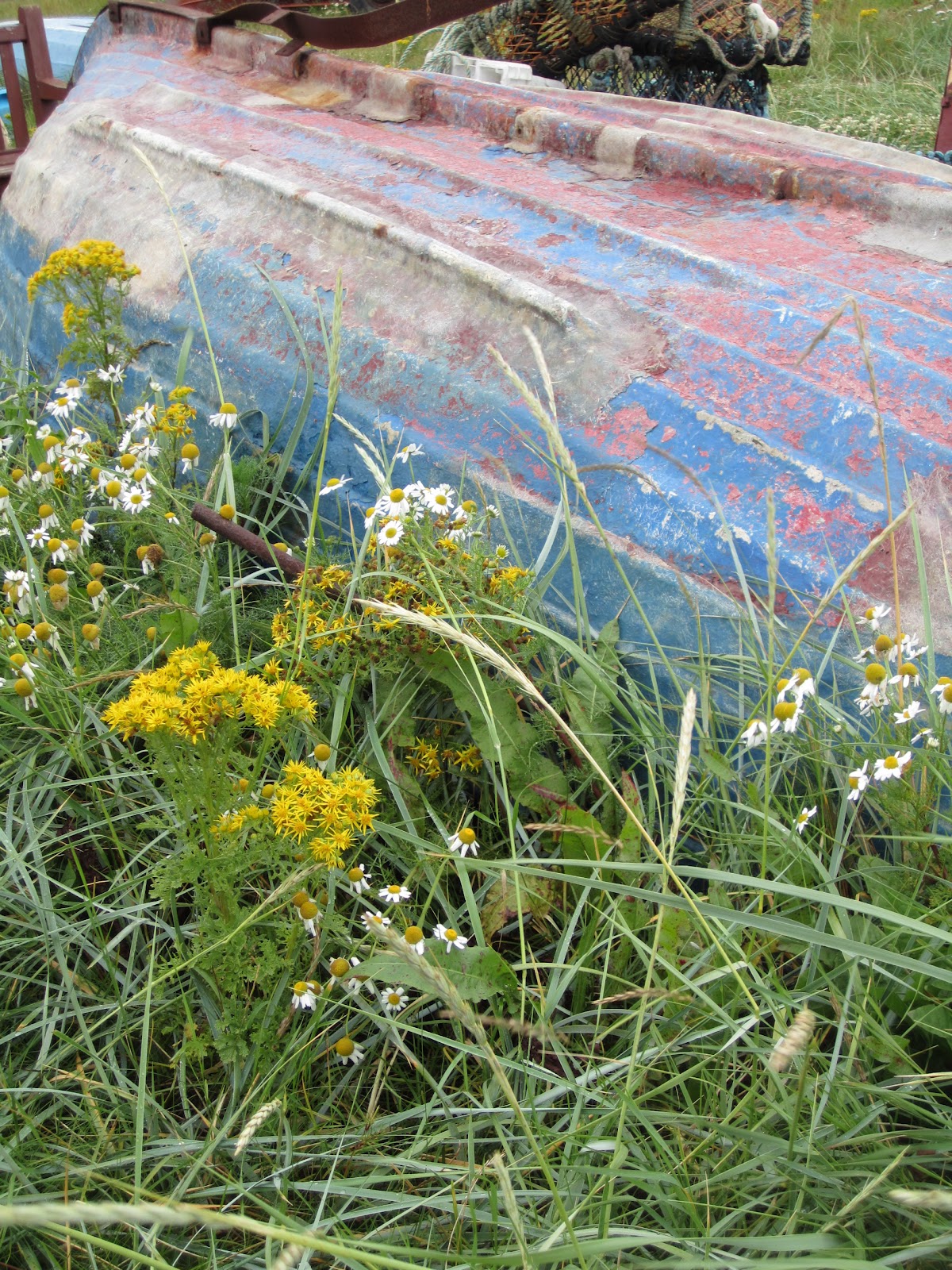
How is this shown on the island? One way could well be the flora that flourishes here. Most of the island is covered in a matting of greenery and varied vegetation. From a distance or a pacing walk nothing much to look at. Sandals, walking boots and trainers regularly and carelessly cover the ground; climb the cliffs or wander the bridleways without a second glance at what is underfoot. The focus being on where they are going - not where they are now. 


But the life underfoot and spilling from walls and cliffs is precious and unique. Each flower a miracle in itself; a celebration of creative giftedness as they survive the salt winds and coarse sun to bloom in celebration of life calling to life. Some so delicate you would imagine them cossetted in a glasshouse and admired through a lens.


 And here they are; pilgrims from the mainland; hermits in the clefts and gullies of the rockspaces; martyrs in the giving of themselves; saints in the divine beauty that they reveal. And I know hardly any of their names. 


A visit last year resulted in this reflection -


Blessed be

The Northumbria Community's Compline for Wednesday is here

wordinthehand2012

Saturday, 25 August 2012

Feast of St Ebba


c615 - 683

Ebba was a princess, the daughter of King Æthelfrith of Bernicia and Acha of Deira. Her brothers were the Kings, Oswald and Oswy  and with their support she established a monastery at Ebchester and later at urbs Coludi, now known as Kirk Hill at St Abb's Head, latterly evolving into Coldingham Priory. This religious house lasted for about 40 years and was a double separate monastery of both monks and nuns governed by Ebba.

Legend says she became a nun to avoid the attentions of a certain Prince. Seems that women who want to be valued for who they are quickly turn to God. However, he refused to give up and it is said that due to her prayers the tide stayed high around Kirk Hill for three days and protected her.

Ebba was a great teacher and politician, bringing Christianity to the pagan Angles who had been settling along the east coast of Britain since the 5th century. 

The reality of life in the early Christian establishment was not always strict on sexual piety. Due to the noble background of members of the religious community, the monastery would also have been a place for eating, drinking and entertainment. While Ebba, herself was noted for her own piety, it seems that she would withdraw from the community rather than providing the necessary discipline at the monastery. As often happened when people are not naturally drawn to the rigours of religious life the monks and nuns found their own amusements. Perhaps she should have taken some instruction from Hilda who was seemingly ruling Whitby with a rod of virtuous iron.

It is told that St. Cuthbert would visit Ebba's monastery to instruct the community. At night Cuthbert would disappear to bathe and pray in the sea, to stop himself succumbing to temptations of the flesh. Very early one morning, a monk from the monastery spied him praying and singing psalms in the sea and as Cuthbert came ashore, he saw or imagined he saw two otters bound out of the sea and join Cuthbert in prayer.

Shortly after the death of Ebba, and as foretold in prophesy by the monk Adamnan, the monastery burned down. The  site was abandoned, and by the first half of the 8th century, as Bede confirms, the site was deserted. However the gifts of Ebba in bringing the Christian religion to this part of  Scotland was not forgotten, and in a book written about c.1200 by the monks of Coldingham, they tell of many pilgrims visiting the Kirk Hill and the spring at Well Mouth, located at the top of the beach now called Horse Castle Bay. St. Ebba's feast day is celebrated on 25 August.

Blessing of Ebba

May you know your own self
In the image of God's eye
May your own self be wise 
In the hearing of God's voice
May your own self be kind
In the speaking of God's word
May your own self be courageous
In the knowing of God's love
May your own self know itself 
In the image of God's eye

Blessed Be

wordinthehand2012


Tuesday, 15 May 2012

Feast of Brendan the Navigator


St. Brendan of Ardfert and Clonfert, known also as Brendan the Voyager, was born  near the present city of Tralee, County Kerry, in 484; he died at Enachduin, now Annaghdown, in 577. 


For five years he was educated under St. Ita, "the Brigid of Munster", and he completed his studies under St. Erc, who ordained him in 512. Between the years 512 and 530 St. Brendan built monastic cells at Ardfert, and at Shanakeel or Baalynevinoorach, at the foot of Brandon Hill. It was from here that he set out on his famous seven year voyage for the Land of Delight together with anything from eighteen to one hundred and fifty brother monks.


The old Irish Calendars assigned a special feast for the "Egressio familiae S. Brendani", on 22 March; and St Aengus the Culdee, in his Litany, at the close of the eighth century, invokes "the sixty who accompanied St. Brendan in his quest of the Land of Promise". As part of the journey, it is said that he and his monks came to ground on a small island that was actually the back of a great whale. Whether the journey was factual, geographical, spiritual or legend is continually under debate. Many historians and archaeologists offer their theories whilst navigators, shipwrights and sailors test their own skills to prove or disprove the tales. Perhaps their first question should not be 'is it true?' but rather 'what does this tell us?'. 


The inspiration of the voyage, brought pilgrims and students flocking to Ardfert. In a few years, many religious houses were formed at Gallerus, Kilmalchedor, Brandon Hill, and the Blasquet Islands, in order to care for those who came for spiritual guidance to St. Brendan.


Having established the See of Ardfert, St. Brendan proceeded to Thomond, and founded a monasteryat Inis-da-druim. He then journeyed to Wales, and to Iona. After a three years' mission in Britain he returned to Ireland, and followed his missionary path to Leinster, especially at Dysart,Killiney, and Brandon Hill. He founded the Sees of Ardfert, and of Annaghdown, and established churches at Inchiquin, County Galway, and at Inishglora, County Mayo. 


After his death,  St. Brendan was buried in Clonfert, and his feast is kept on 16th May.


A Brendan Blessing

May your life be held in the coracle of the Father's hand
May His vision be your sextant and compass 
May His Creation be a wonder to your eyes

May your life be held in the nets of His gentle Son
May his friendship be your crew and your navigator
May his peace be your food and your drink

May your life be held in the sails of the Spirit's breath
May her light be your stars and your charts
May she guide you through doldrums and storms 

May your journey be blessed by the Sacred Three
May you set forth each day for the Kingdom
May your heart be restless 'til you reach the Western shore

Blessed be


wordinthehand2012